Worried that the next time the Texas Lege considers a bill to remove the requirement that legal notices (both ones by governments and ones that government requires of private entities, like letters to creditors on wills, oil injection wells, etc) be published in newspapers, the Texas Press Association has
partnered with a company called Column to have all member newspapers post copies of their legals on a Column-maintained TPA sub-website.
Several things?
One, my newspaper pair is in a small but nonexistent minority of weekly papers around the country that still doesn't have a website. Period. So, the Texas Lege could use us as Example A on why posting on any website is good because we don't have one; we are still old-fashioned print only.
Even if this weren't the case with my pair of weeklies and a few others, the existence of Column, above individual newspapers doing public notices both online and in print, is no guarantor (none, zip, zilch, nada, TPA) that the Texas Lege won't still pass a public notices bill. Ditto for other state press associations already partnered with, or considering partnering with, Column.
(Update, July 5, 2023: Per the newest TPA Messenger, in a bill that flew under the radar screen because TPA officially supported it, the devil's deal with Column is complete. Per SB 943, now signed into law, TPA members are required to post to the state's legal notice website. And, until SB 943 is modified, which it never will be, that site CANNOT be paywalled, per the bill:
The association must ensure that the website:
(1) is accessible to the public at no cost.
So, it's free, and also MUST have an email alert sign-up and other things? What's to stop the Lege, two years from now, from saying something to the effect of: "This is working great; we don't need no steenking newspaper notices in individual papers"?)
Second, Column itself doesn't impress me in some ways, and even worries me in others.
First of all, one of their staffers was sending out one or more emails a week to newspapers that hadn't yet done a Zoom meeting with them. I explained our situation and said I don't see the benefit, and I was told that this could be in violation of TPA bylaws. Well, bring a stick down on me that may or may not be true anyway. (Update: Now that I've grokked through the bylaws, with link, Ms. F. appears to have been full of crap on that claim, whether it was more from ignorance, or more from a willful misrepresentation as part of a lead-in to her sales pitch. I uncharitably am assuming the latter.)
Secondly, the Zoom meeting told me that this was of little benefit otherwise to small, rural papers.
Third, it was sales pitch as much as anything. And, I VERY MUCH didn't like that.
Column's rep said it had three options for uploading legals. One was paste (words) or drop-and-drag PDFs (and RTF docs?) onto the appropriate webpage. Second was using an FTP server.
Third? They offered a full proprietary system where, using your standard font, column inches width, etc., they format PDFs for you on text-only legals, and maybe on PDF legal displays, too (didn't ask about that), then do affidavits, billing, the full 9 yards. No extra cost to you the newspaper, but yes, an extra 10 percent to the city, county, school district, lawyer, oil driller, etc.
No use to me. It would take more time for me to work with that than the time I spend now.
Daily paper? Sure, useful. Bigger daily, useful enough for it to shit-can a classified ad salesperson, clerk, whatever. And, no, no entity is going to place a legal in my newspaper via TPA's web portal for placing legals.
Anyway, HALF of what was NOT "a few minutes" or "10 minutes" but a nearly 40-minute meeting was devoted to the Column rep explaining Option 3 in detail. I know sales pitches and this was a sales pitch with full spiel and all.
Hard pass even if I were repping a daily.
Related to that, as part of the early part of the meeting, I got a thumbnail version of Column's origin story. Was informed that it's a public benefits corporation.
Big fucking deal. Hucksterman and Chan created a public benefits corporation, and when I saw some alleged Skeptics(TM) types touting it, I looked at California's public benefits law. RIDDLED with Mack-truck sized loopholes.
I don't know if Florida's public benefits incorporation laws (where Column is physically located) have as many loopholes as California does for a California benefits corporation, but here's some things I noted elsewhere about the Huckstermans' move.
Some pseudoskeptics claimed that that a
California benefits corporation, which is the type of LLC the Chan Zuckerberg Initiative is in
California, will keep him in line.
The only way to "enforce" whether such a body is living up to its charter, etc., is through a "benefits proceeding."
However, such proceeding is all "inside baseball":
(a) No person may bring an action or assert a
claim against a benefit corporation or its directors or officers under this
chapter except in a benefit enforcement proceeding.
(b) A benefit enforcement proceeding may be commenced or
maintained only as follows:
(1) Directly by the benefit corporation.
(2) Derivatively by any of the following:
(A) A shareholder.
(B) A director.
(C) A person or group of persons that owns beneficially
or of record 5 percent or more of the equity interests in an entity of which
the benefit corporation is a subsidiary.
(D) Other persons as have been specified in the
articles or bylaws of the benefit corporation.
(c) A benefit corporation shall not be liable for
monetary damages under this part for any failure of the benefit corporation to
create a general or specific public benefit.
So, that would mean the Chan Zuckerberg Initiative corporately, or any
shareholders or directors named Priscilla Chan, Mark Zuckerberg or
cronies thereof, of such persons unlikely to hold more than 5 percent of
the Initiative's stock, are the only people who can do anything about
its performance.
Speaking, what is a “public benefit”? In California’s enabling law, it says it is:
(D)efined as a material positive impact on society and the
environment, taken as a whole, as assessed against a 3rd-party standard,
as defined, that satisfies certain requirements.
But, that “third party standard” is undercut by lack of third-party enforcement.
Wikipedia’s article itself notes this, too:
Benefit corporations need not be certified or audited by the
third-party standard. Instead, they use third-party standards solely as a rubric a
company uses to measure its own performance.
A “rubric.” Is that like a “goldbrick”?
But, I didn’t yet answer what that “specific public benefit”
is. Hold on, we’re there:
(e) “Specific public benefit” includes all of the
following:
(1) Providing low-income or underserved individuals or
communities with beneficial products or services.
(2) Promoting economic opportunity for individuals or
communities beyond the creation of jobs in the ordinary course of business.
(3) Preserving the environment.
(4) Improving human health.
(5) Promoting the arts, sciences, or advancement of
knowledge.
(6) Increasing the flow of capital to entities with a
public benefit purpose.
(7) The accomplishment of any other particular benefit
for society or the environment.
Look at No. 7. Ain't THAT a Mack truck-sized loophole?
OK, more analysis time.
And, again, per Pro Publica, Hucksterberg gets to save on his tax bill while doing all of this.
So what are the tax implications? They are quite generous to
Zuckerberg. I asked Victor Fleischer, a law professor and tax specialist at the
University of San Diego School of Law, as well as a contributor to DealBook.
He explained that if the LLC sold stock, Zuckerberg would pay a hefty capital
gains tax, particularly if Facebook stock kept climbing.
If the LLC donated to a charity, he would get a deduction
just like anyone else. That’s a nice little bonus. But the LLC probably won’t
do that because it can do better. The savvier move, Professor Fleischer
explained, would be to have the LLC donate the appreciated shares to charity,
which would generate a deduction at fair market value of the stock without
triggering any tax.
Let’s remember that by him paying less tax, you and I have
to pay more for the same government services.
I have no idea if Florida's public benefit organization is anything like California's. But, if it's even close, Column is getting to run a for-profit corporation as a quasi-charity, claiming its "public good" is protecting newspaper public notices, and with that 10 percent off the top on its "let us do it for you option" on legal notices, laughing all the way to the bank while possibly getting some tax write-offs, too. And, per a piece by the Orlando Sun-Sentinel about the creation of Florida's law, it sounds like that is in the same ballpark as California.
So, I now wonder how much of a hard (and fast paced) "sell" TPA got in the first place.
Update: To put it more bluntly, riffing on Gale Sayers and Brian Piccolo? For Column:
- Column is first;
- State press associations are second;
- Individual newspapers are third.
That's the way I see it.
So, how much does TPA get from Column for the "privilege" of it working hand-in-glove to undercut individual member newspapers? Since TPA is not a government (and ditto for other state press associations) it/they aren't subject to state public information / open records laws. And, since I'm not a TPA board member, I can't find out that way. If anybody knows ....
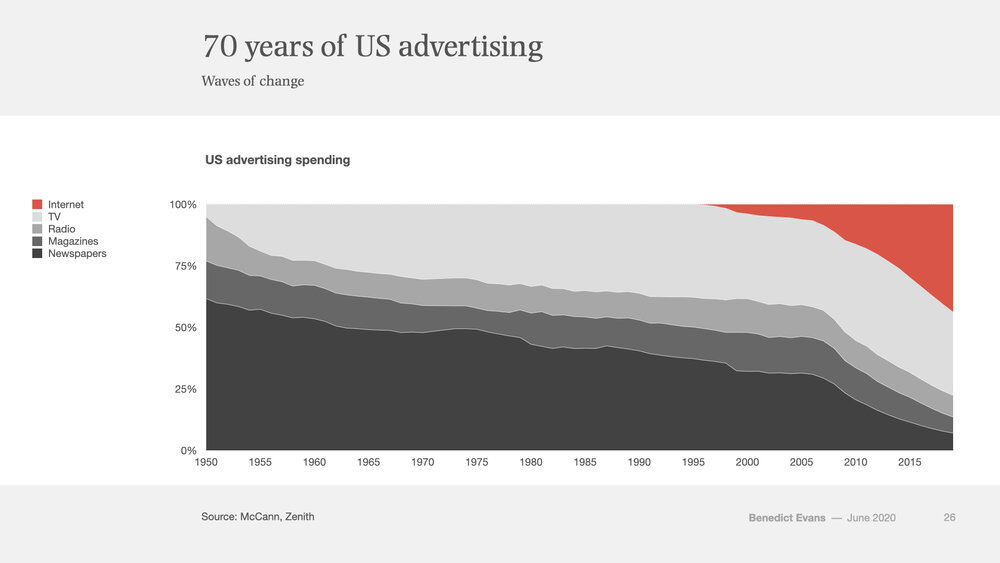
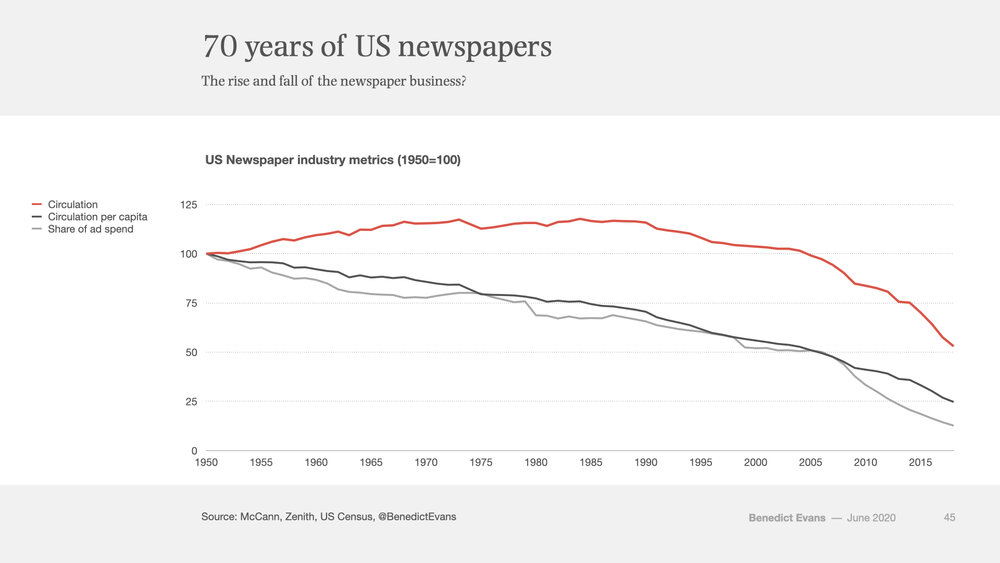
As for Column's origin story? Well, newspapers shot themselves in the foot as much as anything, Jake. When Dean-o Singleton touted the "TV model" for online newspapers, even though pay cable channels (HBO and Playboy came to mind when I first critically examined Dean-o's md-1990s statement while chairman of the board at AP) had existed since the 1970s, maybe his idea was partially excusable. But, without any benefit of hindsight, it was not totally excusable. Nor was it totally excusable for newspapers to dawdle without paywalls not only into the early 2000s, but even after the Great Recession hit, and started gutting whole classes of display ads, like cars and real estate, beyond the classifieds that Craigslist had already hit. It was even less excusable for Dean-o to trot out I-News, a "lather, rinse, repeat" of the Dallas Snooze's CueCat, after it had already flopped. I also don't get how Jake Seaton could not only be part of a multi-generation daily newspaper family but, even after being a reporter at their newspaper himself, still not know what a public notice was. (I've gotten the occasional story out of a public notice, for doorknob's sake.)
And, speaking of all of this? Column's public notices webpage for TPA is of course ...
NOT PAYWALLED.
Also of interest? Column is NOT a TPA associate member, as of a check just a month ago. Such caring.