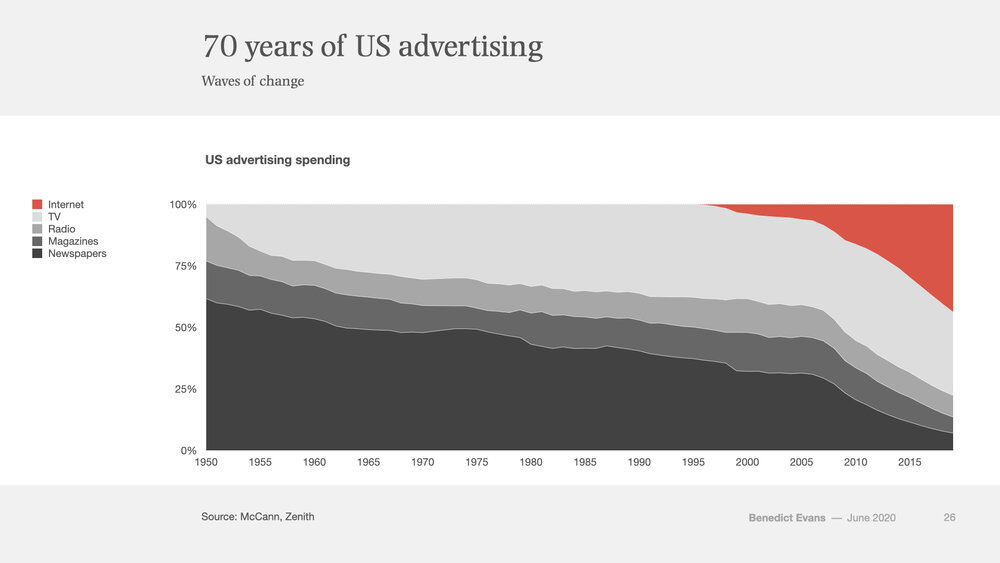
This excellent post, with LOTS of detailed graphics, backs up a blog post of mine from last year, when talking to a programmer at an entry-level broadcast network TV station. He said that, especially on news, TV advertising hadn't taken hits.
Wrong.
Now, to be sure, TV's degree of hit hasn't (yet) been as harsh as newspapers. But, in terms of percentage drop? The Net really accelerated about the time the Great Recession hit, and it hit TV as hard as it did radio.
My take on the mainstream media, especially the newspaper biz. As a former long-term Dallas Metroplex resident, this is often focused on the sometimes good, and the often not-so-good (compared either to what it could be or what it used to be) of A.H. Belo's primary publication, The Dallas Morning News.
Thursday, June 18, 2020
Thursday, June 11, 2020
Calling out the NYT on its Overton Window
So, the Old Gray Lady said goodbye to James Bennet as NYT op-ed head last week. He won't be missed. Will his temporary or permanent successor reign in Bret Stephens or Bari Weiss? Probably not. Move Teapot Tommy Friedman out to pasture? Unlikely.
That's the theme of Kenan Malik's commentary at The Guardian.
Shorter, and sharpened, Malik?
The New York Times has erected its own Overton Window for the past three years. He mentions Stephens; dunno why he passed by Weiss, unless ultra-Zionism isn't on his radar screen, or unless he felt Stephens was good enough as representative of a class. (Mondoweiss notes that Israeli guest op-eds have had Tom Cotton angles toward Palestinians before, like Schmuel Rosner, one of four such in 2018. One of them was by Stephens.)
The column has other points, though. Yeah, Bennet resigned. Riffing on Malik, this isn't the first time he hadn't read a controversial column, though. So, did the NYT push? Shouldn't it require its editorial page editor to personally read all potential guest columns before they run?
That said, Malik only touches on the tip of the problem. The NYT has long had NOBODY representing blue-collar liberalism on its pages. It's NEVER had anybody representing left-liberalism or beyond.
So, not only has it moved its Overton Window rightward with Stephens and Weiss, it created its own Overton Window in the first place.
If people would stop subscribing to the damn thing, since subscriptions, and especially digital ones, are an ever-bigger part of its revenue, maybe it would listen up.
Not likely, but maybe.
Thursday, June 04, 2020
A way for the feds to bail out local print media, no strings
Poynter has the simply brilliant details.
Have the feds spend some advertising dollars on local print media. Avoid Ad Council, avoid big TV stations, avoid social media.
Sure, there might be a bit more overhead.
But, as Steve Waldman notes, folks still trust their local paper more than social media. Or than national media.
And, right now, with COVID, such trustworthiness is needed.
Thursday, May 21, 2020
The death of the printing press next?
As people in the newspaper biz know, more and more community-type non-daily papers are simply shutting down. More and more small dailies, and even some big ones, have cut back to a non-daily print schedule. Some 30 have outrightly closed, and that doesn't count non-COVID, "regular" declining newspaper industry closures; I know of two this year within 100 miles of me.
So, printing press owners have fewer customers, and the ones remaining have fewer print jobs.
Meaning that printing press owners are themselves hurting.
And getting cutthroat in some of the discounts they'll offer.
A decade ago, it was still a commonplace-type observation that many small newspapers were being bought in part for their printing presses.
Now? What if you bought a press, whether by itself or with the "cover buy" of a group of newspapers, and you've still got outstanding debt on that? Yeah, you feel you have to keep your press running, but ... if you discount enough to take new jobs, you're running harder to stand in place.
IMO, it might be better to not chase new jobs for less money, and if necessary, file for the Paycheck Protection Program. If you qualify, the next step would to see about refinancing that loan, maybe? The next step after that, or maybe before, might be to at least start some discreet feelers for possible sale.
Thursday, May 07, 2020
Newspapers, coronavirus, and the dropoff in special ROP,
non-ROP and ancillary ad-like revenue
What I am talking about, for the layperson, and for newspaper folks who might "aha" if I used different words, at least on the second half of the second line?
First, for the layperson, ROP is "display ads." Or what somebody might even call "picture ads" at a non-daily newspaper if, were there office open right now, and you were to say "I want to buy an ad" and the person helping you might respond, "Picture ad or word ad?"
OK, non-ROP is those "word ads."
Classifieds, in other words.
And ROP is picture ads.
Special ROP is special sections inside a newspaper.
Everybody who knows something about newspapers, including the intelligent layperson, knows something about the ROP dropoff. Let's tackle the rest, starting with special ROP.
Right now, spring/summer travel, bridal and in a month, graduations would be among these special sections.
Travel? When it's unclear what will reopen, and things like musical and sports events, in some cases, or entertainment sites like Disneyland, people are saying "not until fall," you simply can't sell ads to a section like that.
Bridal? Special sections there face similar problems. You can't sell ads about honeymoon destinations.
Graduations? Small high schools will do the best they can, so non-daily papers won't hurt so much. But larger daily papers, if they have had grads specials in the past? Not right now.
Now, to classifieds.
They're off for several reasons.
One is that, to the degree newspapers still have a help wanted section, there's not a lot of people hiring right now. This is hitting all papers alike, from big regional dailies down to community weeklies.
Another is hitting from small community dailies on down.
Nobody's holding garage sales right now, in what should be prime season in the southern tier of the U.S. And, at small dailies and nondailies, at this time of the year, ordinarily that might make up a fair chunk of the classys.
There are a few other areas that have also been hit on the classys page, but that's the biggest I can think of.
The ancillary?
Obits, and similar.
Obits are hurting to a degree because public burials aren't happening right now. Because of that, especially at larger papers that charge by the word or by the column inch? I'm venturing a 10 percent drop there. Obits are shortening and some are moving more toward extended death notices.
On the other side of the spectrum, many non-dailies still don't charge for births, engagements and weddings. But some do. Certainly, small dailies do, and so do mid-sized ones. (I'm surprised large dailies haven't started this. Surely there's a few Buffett cigar butts there.)
Kids are still being born. (That may be different nine months from now, of course.)
But, weddings are on hold right now, because ... where do you have them? where is the honeymoon going to be? Etc.
First, for the layperson, ROP is "display ads." Or what somebody might even call "picture ads" at a non-daily newspaper if, were there office open right now, and you were to say "I want to buy an ad" and the person helping you might respond, "Picture ad or word ad?"
OK, non-ROP is those "word ads."
Classifieds, in other words.
And ROP is picture ads.
Special ROP is special sections inside a newspaper.
Everybody who knows something about newspapers, including the intelligent layperson, knows something about the ROP dropoff. Let's tackle the rest, starting with special ROP.
Right now, spring/summer travel, bridal and in a month, graduations would be among these special sections.
Travel? When it's unclear what will reopen, and things like musical and sports events, in some cases, or entertainment sites like Disneyland, people are saying "not until fall," you simply can't sell ads to a section like that.
Bridal? Special sections there face similar problems. You can't sell ads about honeymoon destinations.
Graduations? Small high schools will do the best they can, so non-daily papers won't hurt so much. But larger daily papers, if they have had grads specials in the past? Not right now.
Now, to classifieds.
They're off for several reasons.
One is that, to the degree newspapers still have a help wanted section, there's not a lot of people hiring right now. This is hitting all papers alike, from big regional dailies down to community weeklies.
Another is hitting from small community dailies on down.
Nobody's holding garage sales right now, in what should be prime season in the southern tier of the U.S. And, at small dailies and nondailies, at this time of the year, ordinarily that might make up a fair chunk of the classys.
There are a few other areas that have also been hit on the classys page, but that's the biggest I can think of.
The ancillary?
Obits, and similar.
Obits are hurting to a degree because public burials aren't happening right now. Because of that, especially at larger papers that charge by the word or by the column inch? I'm venturing a 10 percent drop there. Obits are shortening and some are moving more toward extended death notices.
On the other side of the spectrum, many non-dailies still don't charge for births, engagements and weddings. But some do. Certainly, small dailies do, and so do mid-sized ones. (I'm surprised large dailies haven't started this. Surely there's a few Buffett cigar butts there.)
Kids are still being born. (That may be different nine months from now, of course.)
But, weddings are on hold right now, because ... where do you have them? where is the honeymoon going to be? Etc.
Monday, May 04, 2020
1619 Project: The Pulitzers slouch toward Gomorrah
The only reason I can figure that the 1619 Project won a Pulitzer, despite both scads of historical incorrectness AND crappy editorial oversight at the New York Slimes, as I blogged about earlier, is virtue signaling.
Like Obama winning the Nobel Piss Prize, it seems to be virtue signaling. Hannah Jones, Jake Silverstein et al won because of who they're not.
The real Ida B. Wells, who got a special Pulitzer citation, is eminently deserving. Nikole Hannah Jones, who has the Twitter slugline of Ida Bae Wells? Not so much.
There is a bit of silver lining or two. The award was under commentary, which means OPINION, for Jones' opening essay in the project.
On the third hand, commentary should still be factually based, and this is not, and it still carries the stains of the whole project, because it serves as a framing device.
Friday, May 01, 2020
Alden Capital wants to be saved from itself
and from its hypocrisy, schadenfreude and petard-hoisting
Ben Smith, formerly of ButtFeet and now the New York Times, notes that Alden Capital head Heath Freeman wants Facebook and Google to pay it more for the news they buy from it.
There's several problems here, per the second line of the header.
Above all with the Denver Post, anybody who knows anything about the media, about Alden Capital and how the Venn diagrams of "Alden" plus "media ownership" and "Alden" plus "news writing" are nowhere near the same, know that Alden really is producing almost no news. That's because, even though its newspapers are generally profitable, it's cut them to the bone and beyond, even worse than Craphouse (excuse me, New Gannett), and only to milk them because other things owned by Alden suck. So, that's the petard hoisting.
The hypocrisy is, of course, that were Alden to get paid more, it wouldn't reinvest it in its newspapers. See above.
The schadenfreude is the Alden connection to how newspapers got here in the first place.
In the middle 1990s, when the Internet started looming on the horizon, major papers and the AP started wondering how this might affect them. Well, the AP board of directors decided that the "TV model" showed that advertising would be fine and no online subscriptions needed. This, of course, ignored that pay cable channels existed already then and had for at least 15 years before that.
Now, here's the specifics of the schadenfreude.
Dean Singleton was chair of the board of AP at the time.
Deano, as I like to call him, as many know, owned Media News, or Media Snooze, an early "Chainsaw Al" guy. More on that in a moment. Media Snooze, as part of its growth + woes, became part of Digital First Media, or as it's known here, Dead Fucking Media. The whole conglomerate became part of Alden.
There's your schadenfreude.
So, go fuck yourself, Heath.
And, the additional bit of hypocrisy? "Chainsaw Al" Deano criticizing Alden almost exactly a year ago.
Subscribe to:
Posts (Atom)

