Showing posts with label mainstream media. Show all posts

Wednesday, July 03, 2024

Biden's fitness: Why the MSM, especially DC insiders, are rightly loathed at times

Nepo mommy / DC media insider Susan Glasser on Twitter at the start of the week, presumably with the nodding silence of her husband, nepo dad and insider Peter Baker, ignored that they knew, or should have known, about Joe Biden's problems long ago, and never wrote about it. Then, after last week's debate, said, in essence, "where were all these folks," not counting themselves in "all these folks."

Here's the tweet I was quotingthen it's explainer time:

There we are.

Susan Glasser, per her Twitter bio, is a staff writer for the New Yorker. Hubby Peter Baker is chief White House correspondent for the New York Times. Nepo baby offspring is Theo Baker, who has written for both mom's and dad's sites, as well as The Atlantic and elsewhere. He's a work, a tool, a knob, a piece of shit, and a bigger piece of shit on Zionism issues after Oct. 7, 2023.

And, as screengrabbed by someone else in response to Glasser, here's her running flak for Dementia Joe five months ago:
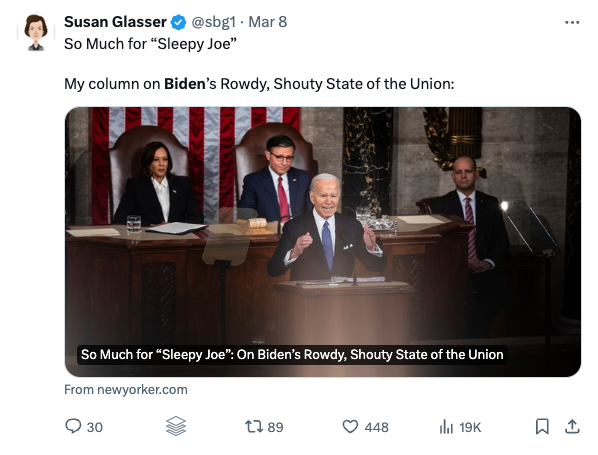
That's who these people are. And, they're unapologetic about wiping their hands, Pilate-like, while throwing people under the bus, or Roman chariot, or on a cross.

And, journos like Rick Perlstein, who should know better, expect me to not duopoly exit, or to never have done it 24 years ago, per yesterday's post? Really? Or, the likes of Will Bunch salute the Philadelphia Inquirer's call for Trump to resign while pretending Biden's new clothes are still splendiferous?

That said, the non-columnist types like Glasser and Baker will claim we're just here to report, not opine. Yeah? Well, your reporting didn't dig that deep, did it, and that was presumably willful, wasn't it?

Related, at least tangentially?

The Philadelphia Inquirer, in a house editorial touted by the likes of its often-good, but BlueAnon, columnist Will Bunch and Blue MAGA shiv slinger Yashar Ali (who's been quiet this year, maybe due to his financial problems), in the wake of Joe Biden's catastrophe at last week's debate, called for Donald Trump to withdraw from the Republican nomination contest.

And, that's a big swing and a miss.

Large chunks of the GOP, sotto voce, as well as the Never Trumpers who have spoken out, yes, want an alternative. But, pretending that many Democrats don't want an alternative to Biden is the whiff, part one. Why not call for BOTH to resign? 

As is, this invites a doubling down of perceptions that the mainstream media is all Democrats.

Ted Van Dyk at the WSJ got it non-partisanly right: "Biden Should Withdraw and So Should Trump." If you're wondering who he is? He's a Dem insider back to the days of working for Vice President Hubert Humphrey. As an advisor on the Hump's 1968 presidential campaign, he knows how things play out.

The reality, deeper than that?

Tim Alberta gets it, and since he's a blue check with more than 280 words, I'm quoting the whole damn thing, with link here in case I misposted:

If only others would, too.

Yes, I also ran this yesterday, but, it needs to be read again.


Thursday, February 16, 2023

Another big fail by CJR: Jeff Gerth reviewing Russiagate reporting

 Yes, THAT Jeff Gerth of long-ago Whitewater infamy wrote a multi-part series reviewing mainstream media coverage of Russiagate.

Beyond his background making this a bad optics issue, his actual work simply makes this bad. After a "backgrounder," Gerth starts part 1 of his review (ye gads, there's multiple parts) with an interview of Trump himself. Does Gerth really expect Trump to tell him anything that's not totally self-serving? That's beyond Gerth opting for "scene-setting" vignettes like this:

During my interview with Trump, he appeared tired as he sat behind his desk. He wore golf attire and his signature red MAGA hat, having just finished eighteen holes. But his energy and level of engagement kicked in when it came to questions about perceived enemies, mainly Mueller and the media.

DUH! Of course he perked up. Seriously. This is bad optics for CJR.

Presumably, other reviewers could have picked up on Bill Clinton's pre-2016 ties with Vladimir Putin.

Second, there have been other journalists critical of MSM coverage besides the troika, all problematic, of Glenn Greenwald, Matt Taibbi and Aaron Maté. 

And, given what Duncan Campbell recently said about him, having Kyle Pope edit Gerth's series is ... interesting. 

On the other hand, Vox, from whence I saw the CJR piece, continues to try to connect the dots of a circus clown picture into a Monet water lilies painting on Russiagate, and continues to fail. It might have done better than a defensive critique of CJR and used someone other than Andrew Prokop.


Monday, October 26, 2020

Twosiderism, the MSM, and Kool-Aid drinking

(Sorry that I had originally published this, and backdate published it, before it was ready.)

 I've used that last phrase elsewhere about people like Aaron Maté, Max Blumenthal, Mark Ames, Jordan Chariton, Yasha Levine, Matt Taibbi, and others.

They're a loose cluster of people who claim to think outside the box of what I call the bipartisan foreign policy establishment here in the U.S.

However, they carry this to an extreme, and that's the twosiderism on their own. Especially on things like China's Uyghur detention camps, they're willing to drink Xi Jinping's bullshit or whatever just because the U.S. foreign policy establishment calls him out for this. (As does most the Western foreign policy establishment.)

Well, beyond two wrongs not making a right, this is not really outside-the-box thinking. Instead, it's creating your own new box.

On things like the New York Post's story about Hunter and Joe Biden, Glenn Greenwald has been a willing member. And, he too is wrong.

Yes, it's Vox, Ezra-land, but Jay Rosen, who is interviewed there by Sean Illing, isn't Ezra Klein.

Rosen just mentions the Post piece in passing as part of a larger issue. And that is that political journalists have for decades more and more treated political reporting as insider baseball. 

There are two other problems he mentions.

One is commercial pressures. Here, the equivalent of the old "if it bleeds it leads" would be "if Trump tweets he leads."

The second? The MSM's long desire for "the view from nowhere" or "equal time." Well, on broadcast media, the Fairness Doctrine hasn't existed since Reagan. Print media has never been bound by any such thing. Electronic media of the Internet era of course isn't.

Rosen does say that leaders in the MSM have adapted a little bit to Trump exploiting the "fairness" issue. Not as much as they need to, but somewhat. The "if Trump tweets he leads"? In their DNA, though.

To the degree they are truly playing inside baseball, the Times etc. deserve a callout. But, where are the stenos calling out the Post slouching more toward Gomorrah? Or the Wall Street Journal making its news pages a harbor of coronavirus conspiracy theories, herd immunity puffery and antimasking?

Friday, September 20, 2019

More reasons not to trust Politifact

All the fact-checking agencies have problems from time to time. With many of them, part of their problem is that they have a target audience of the gamut from Never Trumper Republicans to mainstream Democrats — ie, the sweet spot within the duopoly.

Or, to put it in terms of bipartisan foreign policy establishment and inside the Beltway stenos, that's their target audience.

But, per a Politifact scoring of Rachel Maddow's "guns" question to Bernie Sanders, there are other reasons to question Politifact, as I explained there.

What Politifact is doing the scoring? Politifact National or a state Politifact?

What? There's more than one Politifact?

Damn straight, and Poynter doesn't explain why it uses just one media outlet in state-level Politifacts where it does that, rather than a university's journalism department, which it does elsewhere. And in those states, it doesn't explain why it uses just that university J-school.

Is there some "branding" involved? Behind that, some financial consideration?

Wouldn't surprise me.

Beyond that, though he's writing about the Washington Post's fact checkers, and about them versus Sanders as being too radical, Jeet Heer's cautions can be extended beyond that. Politically weaponizing fact checking is a dangerous proposition. In this particular case, he says it can give Trump an opening to questioning the whole enterprise.

Tis true both ways, Jeet. Spin-doctoring fact checking in Bernie's favor, as I have just pointed out, does the same thing.

And, some of this then goes to Beltway media using fact checkers as part of horse-race coverage of political campaigns.

"They're up to 113 Pinocchios in the last six months!"

It still doesn't address Poynter's lack of transparency. Or other issues with Poynter beyond, but including, Politifact.

And this is not the first time I've blogged about problems with Politifact.

Wednesday, September 11, 2019

Is CJR pulling punches in the face of Zionism?

Columbia Journalism Review recently had a good piece about how, within the precariat that is modern journalism, editorial cartoonists have become a precariat squared.

The main thrust of the piece is that cheapskate owners in general, and wingnut owners in particular using finances as an excuse, have accelerated the die-off, killing off cartoonists who won't toe a MAGA line.

However, the piece was sadly spoiled in the middle by this:
In April, after the Times international edition published an antisemitic cartoon, James Bennet, the opinion editor, who oversaw cartoons, disciplined the production editor responsible and dumped the syndication service that had provided the offensive image. Two months later, Bennet vowed to never publish a cartoon in the international edition again. Patrick Chappatte and Heng Kim Song, the international edition’s two in-house cartoonists, who had nothing to do with the image in question, lost their jobs. Joel Pett, a Pulitzer-winning cartoonist, called the move “chickenshit.” 

Well, that's probably not the most chickenshit thing.

CJR showed several anti-Trump cartoons, but not this one. It wouldn't even link to a site that showed it. 

I'll do both.

Here's the cartoon as it appears in Haaretz:


Why did I go there?

Because Haaretz has it in an opinion piece which says, in essence, the cartoon isn't antisemitic and that it's run worse itself.

As much of the mainstream media (and apparently the media that analyzes the mainstream media) still kowtows to Zionist stances, it's important to call it out. Many journalists know the truth about these issues — that American newspapers still self-censor a lot on Zionism issue and self-censor a lot more than Israeli papers do.

Shame on CJR (and Sam Thielman as author) for being too cowardly or craven to not even run a link, let alone the actual cartoon.

After all, it ran pictures of multiple allegedly anti-Islamic Charlie Hebdo cartoons.

Thursday, April 12, 2018

MSM Bingo, Texas version

We've got a runoff for the Democratic gubernatorial nomination between the the incompetent (so far) Loopy Lupe Valdez and the insufferable "I personally" Andrew White.

Meanwhile, last week, the Austin Stateless was sold to Gatehouse's parent for pennies on its one-time dollar. This just a year after the Dallas Snooze outsourced its pagination/copy editing to Gatehouse.

What do these two things, and others, have in common? This graphic of mine below.


This is primarily about newspapers, from my expertise. But, one magazine that you should know is included. So is the pack of TV and radio stations, more and more of whom are owned by folks like Sinclair.

Of course, the clear square does mean something. It is certainly understandable by me. But, the ownership class at the media knows that well and continues to exploit it. The bottom, lightest-shaded square in the gray column also means something in the big picture of media things in the Pointy Abandoned Object State™.

The bottom left square also means something, in a reverse-snark way. And, in a real way, non-daily papers, with smaller five- and six-day community dailies at least somewhat on the same side of the fence, face their own worries.

A lot of the other squares, though? Newspapers, not just with ownership, but with upper-level editorial staff, are digging their own graves.

Take the Dallas Snooze, with a clickbait child-level header on a story that wasn't much more than a nothing burger and certainly not "investigative journalism," about city sewage infrastructure, which the Observer first gave a moderate level skewering by Stephen Young, then the full Monty by Jim Schutze.

The actual story? And the Curious Texas project behind it?

This belongs on Quora, not a theoretically serious and theoretically major daily paper. (And, thus, the death of a thousand cuts from the online world goes both ways.)

If the Snooze wants to keep this Curious Texas project, accept questions like this and do stories on them, at a minimum, it would go with non-clickbait headers AND writing. And, they should be no more than, oh, 300 words?

As for Ms. Jennifer Emily?

You're on MuckRack, too? Hope you've raked actual muck.

Thursday, January 04, 2018

No, Jay Rosen, this Yascha Mounk screed was NOT the story of 2017

Albert Camus wannabe Yascha Mounk
Journalistic overviewer and sometimes scourge of the industry Jay Rosen says this NYT piece by Yascha Mounk is "the story of the year." 

Well, to expand on a Twitter thread of mine last week, maybe, maybe not. Or, to move from the teaser? Probably not that close.

First?

Rosen also knows the history of US journalism, and that, before its alleged golden age, we had an openly partisan press. (See more below on this.) Now, there was no electronic media, let alone social media, and presidents were relatively weak. But, are these more differences of kind, or of degree? Rosen doesn't answer, and his Tweet did NOT appear to be part of a thread.

Second?

This is just a brief point, but I must note it. We must remember that this is an op-ed, not a news piece. Rosen knows that as well, but didn’t note that in his Tweeting either. Yeah, op-eds can at times include news analysis. This one doesn’t. It’s a straight opinion piece. So, Rosen's Tweet shout-out is itself a bit iffy.

Third?

We must also ask, which the op-ed does not, how much of this, or how little, in Trump's case is deliberate strategy? With Modi, Erdogan, etc., that's not a question; we know it. But in Trump's case, some of this is simply narcissism. Now, tis true that actual dictators may be driven by similar narcissism. But they aren't always so. Take Erdogan's predecessor Ataturk. He ruled with a relatively light hand over Turkey's media.

Related?

Mounk also ignores the clownishness of Trump and his ilk. That's related to the above. But, per the quip that Mussolini made the trains run on time, I'm not sure Trump could make his own bowel movements run on time. (I must add that John Kelly as the latest chief of staff appears to be doing some of that, while also appears largely simpatico with Trump's political beliefs.)

Fourth?

He ignores other factors.

If Hillary Clinton had a cakewalk lined up after Biden took a pass and Bernie treated her with relatively kid gloves, Trump had his own good fortune.

Mitch McConnell would never leave his Senate mancave. House GOPers were too fractious for anybody to emerge. That left smarmy Booger Ted Cruz as the most viable alternative after Jeb! Bush had an even worse campaign than his first try at being Florida's gov, Little Marco Rubio and his Marco Polo-ing himself, Carly Fiorina reminding us she is as inept a CEO as Trump, and god ... I mean George Pataki at one time talked about running, which shows how craptacular the GOP field was.

That's even as Trump henchman Steve Bannon claims Donald Duck is the best political orator since William Jennings Bryan. No,really!

Fifth?

Mounk — and Rosen, for good measure — also overlook bits of authoritarianism from Dear Leader even before Debbie Wasserman Schultz tried to rig the Dem primaries for Hillary Clinton. That includes his AG, Eric Holder, spying on the Associated Press, and his AG's FBI impersonating an AP reporter, among other things.

And, speaking of? 

It's also "amazing" that neither Mounk nor Rosen notes the possibility of neoliberal authoritarianism, even as in France, as we speak, Emmanuel Macron seems to be acting sub specie Louis Quatorze with the idea of "L'etat, c'est Macron!" And here is a GREAT profile of him being just that. The author also notes that Mounk cluelessly thinks Macron is boosting democracy even as he's undercutting it. (Maybe it's not cluesless, though; per the piece, Mounk may be enough of a neoliberal elitist to claim that IS democracy.)

Sixth?

Not everybody on Fox plays along with such things. Not even counting Shepard Smith, it's not as monolithic as Mounk claims, and I know Rosen knows that, and that it's not the same as World News Daily or even worse.

And, to the degree a relatively sane bigger conservative media player like Fox is involved, if it goes overboard for Trump, there's the possibility of getting burned even within the GOP later. Say a paleoconservative or Paulist is the next GOP president; to the degree Fox still has warmongers, it could be out of the loop.

Related to that?

As both Mounk and Rosen should also know, and maybe do know, the real authoritarianism isn't so much with Trump but with one faction of the conservative movement that has glommed on to him, starting with Rupert Murdoch — and Murdoch at the WSJ, which he still runs himself without as much interference from his kids as at Fox. Sam Tanenhaus has the details.

Granted, that’s not the same as governmental authoritarianism. It’s more cultism. But Trump would by no means have the same apparent power as he actually does if more of the conservative media and think tank world were more oppositional and stronger in it.

Seventh?

How about a sense of history?

That's not to say this isn't some kind of a problem, or that it's not worse, even if "only" in degree, than the Gilded Age partisan journalism. Or, say, the Jefferson-Adams election. Or the Jackson-Quincy Adams battle of 1828. Trump's travel ban doesn't rise to the level of the Alien Acts, and nothing he's done comes close to the Sedition Act. If Mounk, a German native, doesn't know that, Rosen certainly does, or should.

Eighth?

While Mounk notes that Barack Obama might have had too much optimism about the American voter and that he might have had his own blind spots about Hillary Clinton's weaknesses,, he has written noting about things like the DNC fraud lawsuit, and appears to be a deep-fried "Putin Did It" person. Jay didn't note that, either. And, it took me just 30 secs with the Google to find his "Putin Did It" and his lack of concern about the DNC.

Finally, he's a fellow of both New America and the German Marshall Fund. In other words, some sort of left-neoliberal interventionist.

Yes, not everybody at New America is like that. I’ll call a Matt Stoller a left-left-neoliberal. ((I’m not ready to call him a leftist.) German Marshall Fund, on the other hand? Mix of straight neoliberalism on domestic issues with straight NATO/Atlanticist “consensus” on foreign policy. People at a think tank like that write "consensus" foreign policy pieces for places like the NYT, or CNN (the Obama link).

In other words, the type of people who might not like Trump because he might create a non-“consensus” foreign policy. The type of people who might, elsewhere, smear Jill Stein for appearing on RT.

Either Rosen knows these things better, too, or maybe he gives too much credence to the "Putin Did It" bullshit himself. (He doesn't actually write that often at his website, and what he has during this year doesn't even mention the Russiophobia McCarthyism 2.0, and the MSM's part in fueling it. He has, elsewhere, mildly scolded the Deep State but I don't think it's a fixation of him.)

What this does is remind me of why I don't follow Rosen on Twitter, why I think he's overrated, why he's rightly called a liberal not a left-liberal, and is certainly not a leftist. (Anybody who links multiple times to Josh Marshall in one piece, and uncritically, impresses me little.)

Thomas Frank is also not a big fan of Jay Rosen, and rightly so. (Their dialogue also underscores Rosen's political identification is correctly pegged.) That also said, per his dialogue with Frank, Rosen's website, PressThink, is not his alone. It's specifically labeled "a project of the Arthur L. Carter Journalism Institute at New York University."

Ninth?

Jay, you're a wonk about how the media operates. The MSM's uncritical pushing of claims that the Russians hacked the 2016 election and that Trump is a Putin stooge, claims pushed in semi-lockstep with much of the Democratic party, is the story of the year as also noted at The Nation — and specifically the story of the year on media malfeasance.

Rosen also won't tell you, per the Macron link, that Mounk is at minimum, not a fan of the likes of Corbyn, and lumps all sorts of "populisms" together.

My guess is that Rosen is simply signal-boosting Mounk, while content to play along with worshiping neoliberalism in general.

Wednesday, December 14, 2011

Is #AP prostituting itself?

Possibly, if you look at this story:
The Associated Press said Wednesday that it has entered into a partnership with WhoSay Inc., a company that helps celebrities manage interactions with fans through social networks and traditional media outlets.
The AP will give celebrities who are members of WhoSay the option to provide exclusive, personal photos and videos to the AP for licensing to major media companies worldwide. ...

The company puts celebrities in greater control of —and offers the opportunity to profit from— their photographic lives. It also allows them to spread their social media posts easily across sites like Twitter and Facebook. As an example, (Sofia ) Vergara posted a picture of a family lunch in Miami last month. The photo has a copyright symbol, indicating she owns it and can make money from it if, say, a magazine wants to publish it.
At the least, it sounds like it's cheapening itself. Basically, WhoSay looks like an elitist version of Twitter. Which makes it look very much like AP is doing celebrity butt-kissing. Great. AP's entertainment feed will look like TMZ soon.

And, shock me that Dean Singleton, as ongoing chairman of the board (who should have been canned when MediaNews filed Chapter 11) would think this is a wonderful idea. Hell, look at AP's whole board of directors.

Singleton/MediaNews? Chapter 11. Mary Junck/Lee Enterprises? Chapter 11. Donna J. Barrett/CNHI? Should be in Chapter 11, but, being owned by the Alabama state pension system, probably can't be. Craig A. Dubow/Gannett? Should be. Still doing mandatory furloughs, isn't it? Michael Golden/New York Times? The company that has a fake paywall and lies about it. Paul C. Tash/St. Petersburg Times? Lives on its Poynter reputation. Katharine Weymouth/Washington Post? Would be in Chapter 11 if not for Kaplan. Gary Pruitt/McClatchy? Wouldn't surprise me if it winds up there.

As Michael Hirschorn at The Atlantic notes, it's precisely strategies like this that have made the general public undervalue daily newspapers for years if not decades. Add in the AP board originally selling its content to online aggregators for pennies, and the circle is complete.

Saturday, December 03, 2011

New media fluffers profit from dissing old media?

Just wow .... Columbia Journalism Review takes Clay Shirky, Jay Rosen, Jeff Jarvis, et al, to the cleaners. And, the article is very good overall, not just in the claim that these and other new media fluffer leaders, through consulting fees, teaching at public universities, etc., profit, and perhaps hypocritically, by being old media dissers.

And, it's one thing to disagree on what the future of media should be. It's another to profit off of saying what the media SHOULD be, while pretending to be disinterested. And, it's yet another to ignore "concentration" in social media, ethics issues at some social media, and other factors.


Item No. 2 in the paragraph above is why I largely not just mistrust but actually dislike new media fluffers, at least the new media fluffing part of their personalities. Hey, I'm not denying the right to make a buck. BUT, be honest that your new media fluffing is anything but disinterested.


Anway, let's take a look at CJR.


I'm going to run a string of a few quotes, then start commenting;
The establishment is gloomy and old; the (Future Of Newspapers) consensus is hopeful and young (or purports to represent youth). The establishment has no plan. The FON consensus says no plan is the plan. The establishment drones on about rules and standards; the FON thinkers talk about freedom and informality. FON says “cheap” and “free”; the establishment asks for your credit card number. FON talks about “networks,” “communities,” and “love”; the establishment mutters about “institutions,” like The New York Times or mental hospitals....

The problem is that journalism’s true value-creating work, the keystone of American journalism, the principle around which it is organized, is public-interest reporting; the kind that is usually expensive, risky, stressful, and time-consuming. ...


Not only does the FON consensus have little to say about public-service journalism, it is in many ways antithetical to it. For one thing, its anti-institutionalism would disempower journalism. Jarvis and Shirky in particular have reveled in the role of intellectual undertakers/grief counselors to the newspaper industry, which, for all its many failings, has traditionally carried the public-service load.
So far, I'm in total agreement. The FON crowd largely ignores costs and overheads, as do many of their fellow travelers. And, by over-touting social media, etc., can trivialize news. (See below.)

And, is there a solution? Solutions?
Many of Shirky’s prescriptions for the economics of journalism are commonsensical and even wise. A point I find inarguable is that while some news models have been found to work in some contexts-—The Wall Street Journal’s pay wall, ProPublica’s fund-raising model (basically, one big donor), Talking Points Memo’s online ad-based system—nothing to date is scalable. There is no news business “model” at all. And who can argue with his call for constant experimentation?
I would tend to agree. And, that's why I'm not always as hard on this aspect of Shirky's thought as on Rosen's or Jarvis'.


Meanwhile, is the FON crowd counter-cultural? The story suggests so:
If some aspects of peer-production theory and its FON offshoot sound familiar—anti-institutionalism; communitarianism laced with libertarianism; a millennial, Age-of-Aquarius vibe; a certain militancy—some scholars have traced its roots to 1960s counterculture.
I'd say look to today, instead; Shirky, et al, sound like the utopian wing of Occupy Wall Street.

Meanwhile, CJR gets to "throwing under the bus" time, saying Jarvis, as example, and most the FON crowd are ... hypocritical leeches:
Like other FON thinkers, he lives the contradiction of extolling peer production and volunteerism from the security of an institution. It is doubly jarring in Jarvis’s case; an opponent of publicly funded journalism, his journalistic entrepreneurialism is, in fact, publicly subsidized. The “C” in CUNY stands for “City.”
CJR then raises a related issue: the claim that news is a commodity. Of course, the FON crowd starts with one half of Steward Brand's famous quote:
Information wants to be free. Information also wants to be expensive. Information wants to be free because it has become so cheap to distribute, copy, and recombine - too cheap to meter. It wants to be expensive because it can be immeasurably valuable to the recipient. That tension will not go away. It leads to endless wrenching debate about price, copyright, 'intellectual property', the moral rightness of casual distribution, because each round of new devices makes the tension worse, not better.
And, of course, the FON crowd is coming down emphatically, and simplistically, IMO, on the "free" side. That's why they fight paywalls, diss micropayments and other things.  But, as the CJR story notes, paywalls are working, and getting adopted by more and more dailies.

Meanwhile, here's more of that intellectual dishonesty:
I would note that there’s a point at which predicting institutional decline blurs into rooting for it, and then morphs into hastening it along, as the anti-pay wall debate shows. ... “We need the new news environment to be chaotic” to facilitate experimentation, Shirky writes. In fact, though, only consultants “need” the news environment to be chaotic.
CJN's Starkman goes on to say he expects some "media establishment" to remain in place for quite some time.
I’m going to make a bold leap and predict—eenie meenie chili beanie—that for a long time the Future of News is going to look unnervingly like the Present of News: hobbled news organizations, limping along, supplemented by swarms of new media outlets doing their best. It’s not sexy, but that’s journalism for you. 
And, here's why he's at least halfway comfortable with that statement:
It pays to remember that the most triumphalist FON works were written in 2008 and 2009, during journalism’s time of maximum panic. But now, panic time is over.
It is ... and as he says, "muddling" time continues. And, that is no thanks to the FON crowd:
The cruel truth of the emerging networked news environment is that reporters are as disempowered as they have ever been, writing more often, under more pressure, with less autonomy, about more trivial things than under the previous monopolistic regime. Indeed, if one were looking for ways to undermine reporters in their work, FON ideas would be a good place to start.
Indeed, especially about the trivialization. Working at a newspaper that thinks Facebook and Twitter posting will magically fix things seems to illustrate that. When everything is news, nothing is.

Finally, Starkman says that what he calls "Neo-institutional journalism" can be rebuilt, but that it will take work.

Shirky responds, but, IMO, as a kinder, gentler Jarvis more than anything else.

Beyond that, the new media fluffers fail to address how social media, Internet 2.0, etc. threaten us all, not just journalists, with being crushed beneath the wheel, whether like in Hesse's novel of that name or some other way.

Saturday, April 02, 2011

AP source anonmyity gets ridiculous

Here's the latest. On political strategy for a presidential race that won't have its first semi-binding vote for nine months .... granting campaign aides anonymity to "leak" about their boss's campaign plans.
Allies and aides who outlined the path that Romney is charting to the nomination spoke on the condition of anonymity because they were not authorized to publically discuss private strategy sessions.
Ridiculous. "Traditional media" gets worse at this all the time.

Oh, and Philip Elliott of the AP, "publically" is NOT a word. "Publicly" is.

Sunday, March 07, 2010

Anonymous sourcing: ain't just the MSM

Glenn Greenwald rightly bemoans what seems to be a worsening of the use of anonymous sourcing in inside-the-Beltway reporting.

But, as I e-mailed him, this isn't just a "mainstream media" phenomenon.

I’ll hold out Talking Points Memo as a prime example, since it developed from “just a blog” into doing its own news reporting.

A couple of months ago, for example (sorry, don’t have link), one of its staff reported the “latest” on Obama’s heath care push, with a couple of different angles from inside the WH. Nothing close to national security involved, of course.

But... At least five or six different anonymously sourced comments.

Well, I was, to be blunt, disgusted to some degree when I saw that, and I think a few other TPM regular readers were too. That said, neither the reporter nor Josh Marshall commented in response, said we’re sorry, etc.

I’ll venture a guess that as “new media” tries to get more and more into reporting, not just commentary, it will do more of the same selling itself out.

So, let’s not say this is just an MSM problem.