Showing posts with label newspaper advertising. Show all posts

Thursday, June 18, 2026

The Denton Record Chronicle is now officially worse than the Gainesville Register

At least on print editorial management.

The Register, about six weeks ago, finally junked the idea of running three days worth of comics and other lifestyles stuff in each of its two semiweekly issues. Instead, it cut down to one page of puzzles and lifestyle stuff while keeping comics on its website.

That's not perfect, as people who really want comics, and beyond the ones you may have there (the print edition version in the past was slim) can find various free or paid online sites, but it's a good start.

The DRC, which cut fairly quickly through all the stages from seven-day daily down to weekly, not semiweekly, in the year of COVID, still isn't there.

I looked at an issue recently in a library, after having not peeked in months.

The ridiculousness is actually worse.

They are still running comics and all. But? NOT six days. BUT, not one or two days of non-comics lifestyles either.

Instead, it's four days a week, at least in the issue I looked at, even though there are six days outside of Sunday in the seven-day print week and outside of color Sunday comics in the former seven-day print world.

Ad hole still sucks.

Throw out four-plus pages of Readers' Choice / Best Of tout ads, which surely are sold to businesses on a discount rate, unless there's a bunch of dumb Denton businesses there. (Some online-only publication, here's your chance to cut in, by the way.)

Throwing them out, and the total page count with that? Twenty pages.

Of that? Five pages is ad hole. Of THAT? Three pages is classy. You could be better on classy. You should be better on ROP.

Of course, if I toss four pages of comics et al, if I cut to two, you're 5/18, which is 27.5 percent instead of 25. Or toss comics entirely and you're 5/16, which is a bit over 30 percent.

Or if we count your Readers' Choice at 50 percent, but the space at 100 percent, you're 7/24, which is back under 30 percent even with the goose of Readers' Choice. 

And, while you're not asking for my advice? While I'm here, get rid of the daily e-edition. The Register did that too. Unless you're the Arkansas Democrat handing out iPads to e-reader subscribers and otherwise getting aggressive in promoting it, it's a waste of time. 

Thursday, January 29, 2026

GACK on Suzanne Bellsnyder

 Per communication I've seen, she's peddling an op-ed by Hawk Dunlap for other newspapers to use.

Problem? Oh, just one.

He's a currently active candidate for the Texas Railroad Commission.

So, you're offering free advertising to a political candidate, assuming you're doing this in your own newspapers. That means you're managing them as badly as the farm and ranch, which if it's like the rest of your county in the Panhandle, is overdrawing water from the Ogalalla Aquifer. 

As for Dunlap the candidate? He's almost certainly better than GOP incumbent James Wright. Doesn't matter. 

To me, this is cardinal rule No. 1 of newspapers — not giving away free advertising in general and certainly not to state-level political candidates. 

As for the election? Dems have a candidate for the general. Greens? Nobody. Alfred Molison, who ran in 2024, move over to the Ag commissioner race. 

(I am guessing that for Bellsnyder, the primary IS the general election. That's fine as a personal decision, but, beyond giving away free advertising to a political candidate, as an editor, or unofficially an editor/general manager, I would never do that for readers, unless it was a Q-and-A, which many papers do, of ALL primary candidates, or in the general, ALL candidates there.) 

Thursday, March 21, 2024

The Texas Observer's near-demise, one year later

Apparently the Texas Observer's attempted recovery from its near death experience one year ago, mainly due to financial mismanagement, but with bits of other mismanagement and other general problems, as I wrote about at the time, isn't going so well.

At the start of this month? Editor-in-chief Gabriel Arana is now "the former," allegedly to help the Observer as it still loses money, and being replaced by fundraising staff apparently paid off what was his salary. Well, his salary and two other editorial staff also canned. They were explicitly canned to free up money for fundraising staff. The first piece hints at unspecified additional reasons for Arana getting the boot. The two other staffers have spoken in support of the Observer. At the time, at least, Arana had radio silence. 

The Observer and its parent, the Texas Democracy Foundation, continue to cause their own problems on the financial side, as I noted a year ago, for the holier-than-thou attitude of refusing to accept ads mixed with the stupider-than-thou refusal to paywall. I have no sympathy. And, if the recent changes are just the surface of an iceberg, re Arana, will other editorial staff be jumping ship? And, will the fundraising staff broach some Trib-like "pay to play"?

Maybe, re just Arana, wrangling over the Bellingcat partnership led him to be canned? The timing is right, for sure. (He's now at The American Prospect in some way, shape or form, per his Twitter bio.)

==

Update, Aug. 10, 2024: I don't even get their Javascript "please become a member" screen now. That's after clicking to read more than half a dozen stories. Instead, there's a "plea box" down at the bottom of each story.

Saturday, July 15, 2023

A 33 percent adhole in Denton sounds good, right?

 The June 17-18 Denton Record Chronicle had that on 30 pages, if I remember my ad count and page count correctly.

Just one thing. 70 percent of those were frequency rate ads for businesses saying "Vote for Me" in the Best of Denton or whatever exactly the paper's annual contest is.

Whether a quasi-metro paper, a quasi-metro trying to look like a community paper or a community paper, I've  NEVER seen a paper do this. (I hadn't looked as closely at the Wrecked Chronic on this in previous years, I'll admit.) They HAVE to be on frequency rates as this was at least the third week in a row for them to run, if not more than that.

But, even at a big discount, are you THAT desperate? I guess so.

It may say something about the city of Denton, for both better and worse, as well as the Wrecked Chronic.

That said, throw out all those ads (and the page count they generate) and it was 3 1/4 pages of ads on what would have been either 18 or 20 pages. Even on just 18 pages, that's still below 20 percent.

Of course, if you got rid of running six days worth of comics and various puzzles in a weekly newspaper, you'd have 3 1/4 pages of ads on, say, 12 pages of print. That's almost 30 percent.

Of course, nobody this side of being a true idiot would pay Bill Patterson $2.50 or whatever for that. Nor would KERA be half as interested in acquiring that. (And, why are you anyway, and are you paying attention to the Trib, and between this and WRR are you biting off more than you can chew?)

Thursday, July 08, 2021

Dear newspaper publishers: About those legal notices

Yes, I know many of the reasons state legislatures continue to entertain, and to sometimes pass, laws allowing local governments to avoid posting legal notices in their newspapers of record are far less than pristine. In many cases, the local governments as well as the legiscritters are perfectly fine with hiding away such information.

(Then you have schizophrenic, in its non-technical, "split personality" use, bodies like the Texas Legislature. Here in Tex-ass, the Lege will entertain, every other year, in our banana republic not-every-year body, bills to kill public notice. UNLESS it's for setting local tax rates. In that case, the Lege has EXPANDED public notice requirements over the last decade. They call it "truth in taxation," but what it really is, is trying to egg on local wingnuts to file rollback elections and other stuff.)

But, I digress.

With fewer and fewer people reading print newspapers, local governments argue back, "why should we have to pay for print notifications?" Some would just want to post it on their city, county, or school district websites (and probably eighty-six it if they could). Others, more honestly, would argue that posting on a website for a newspaper meets requirements of getting out of local government, while still saving money and potentially addressing more people.

That argument's not all wrong.

And, some local governments might argue that their local publisher wants to nickel and dime them, or even gouge them.

And, THAT argument's not all wrong.

I've seen one arguable "gouging" and a couple of "nickel and dimings."

As newspaper budgets and revenue for many of them get tighter, publishers are going to more and more start running the risk of clutching the public notice brood of eggs so tightly that they smash it.

Tuesday, September 01, 2020

The Gainesville Register can't sell ads?

The Register, formerly the five-day Gainesville Daily Register, but now a triweekly in print that maybe shouldn't be that (and like many others trying the same idea, should ditch the idea of still doing PDF e-editions for all former daily press date), still can't sell ads.

Its three print days a week have each issue selling no more in display ads than each of the five days a week did even before coronavirus' new normal hit.

But, it's even worse on special sections.

My group of weeklies in the area published a 52-page tab for our annual football preview. Almost as many pages as in the past. Ad inches off 10-12 percent, but with more color sales, revenue almost even with last year. Good deal. Adhole was around 50 percent.

The Register? 10-page broadsheet that, once you toss out them running one ad three times and another four times (no, really) had a ONE and ONE HALF page adhole. 15 percent.

Just wow.

Their sports editor has decent to good sports coverage on the words and camera side, as he does in general. Their editor/GM is decent writer or better (other than being amazed by Texas grackles), and if she's dropping pages herself, generally good there.

But they just suck on ads.

And, I expect it to only get worse.

Tuesday, July 07, 2020

Seventy years of newspaper bleed-out, documented

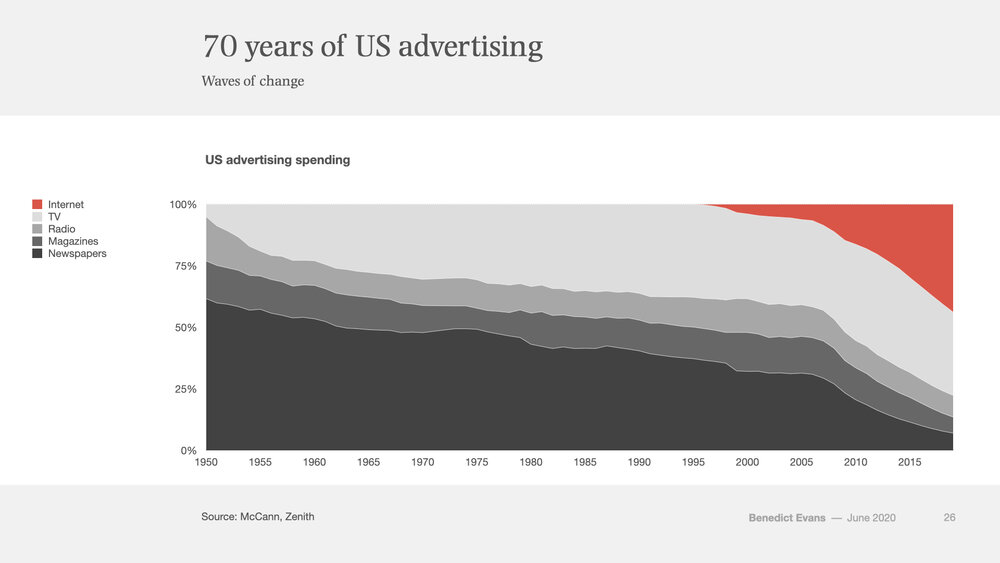
This excellent post, with LOTS of detailed graphics, shows how newspapers have been losing ad share for 70 years, though the fall off the cliff didn't happen until the Great Recession, per this chart:


Interesting trends to note. Per the author, there was a slow taper from 1950 to the early 1970s, then a stabilization, but the decline starts again and runs until the Great Recession, when it picks up steam.

Almost all of that goes to the boob tube. Radio and mags stay steady, basically, until that late 2000-oughts period.

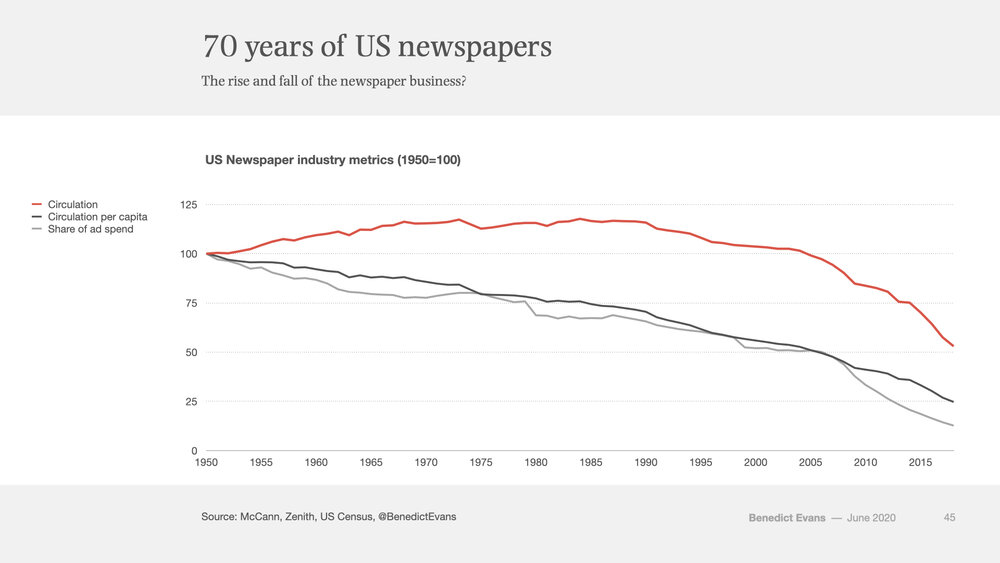
Here's a chart showing why that chart above starts in 1950:


Circ per capita peaked in 1950 and it's been all downhill since then. And, the resume of the slide in the first graph? That happened shortly before total circ peaked. You'll note that its decline also accelerated with the ad decline.

This chart combines the two:


So how did papers hang on that long? Benedict Evans says boosting page count to boost total ad sell, which papers that remained standing as more and more big city papers were going to just one daily, or at least losing one of the three or more they might have in really big cities, in the 1960s and early 1970s.

The Net hit hard when it was able to deliver quality as well as quantity on online ads, and undercut newspapers as what he calls a "light industry."

Look through the whole thing.

Thursday, April 02, 2020

Will the Tampa Bay Times survive COVID?

In the form it had before this week, the answer increasingly appears to be "no."

Tuesday, the paper announced it was cutting to just two days a week in print version, so dire was its dropoff in advertising.

At the same time, it announced one puzzler and one grasping at straws that I've called out before.

The puzzler? It's going to produce a non-printed print edition every day. In other words, the copy desks will be building a regular old newspaper, it just won't be printed. The only reason to justify this is that the Times may have multiple online subscription models and that one of them is based specifically on a PDF-ed e-edition.

It announced it was placing some people on furlough and reducing work hours for others. Why wouldn't you do even more of this with the copy desk, as painful as it would be to them?

The grasping at straws? It's going to put a weekly puzzle book in the Sunday edition.

Nope, nope, nope. Won't help you. At least, unlike the Dallas Snooze, the once-known-as St. Petersburg Times is doing it on a weekly basis, not monthly.

As for the post-COVID world?

My guess is that it will never get back to a full seven-day print version. One option would be going down the road of Advance's papers, and selling only those Wednesday and Sunday papers in stores, while making both like the old "bulldog" weekender editions. Print subscribers would still get the full seven days, but stores just those two.

Another option, of course, is canning the Monday edition for everybody in print. That said, sports fans might miss weekend wrap-ups. Alternative? Can Tuesday. Or Tuesday and Thursday, even.

That said? Since the puzzle books won't save you, you — and other regional seven-days — as you get the increased online subscriptions, will have to at some point raise subscription rates if you never go back to your previous print schedule.

As for this particular paper? Can it and the Tampa Tribune survive as two papers in the Florida Bay Area much longer???

Related question: How symptomatic is this of other regional seven-days? If we consider the whole Florida Bay to be one media market, Fort Wayne and Salt Lake City still have dueling print papers. I'm excluding NYC and LA. Is Dallas-Fort Worth one market? Could the likelihood of something getting at least closer to a JOA betwen the Snooze and StartleGram be closer?

Thursday, February 06, 2020

RIP Bridgeport Index

The Bridgeport Index is closing, not because of a cheap corporate owner, but a family owner who didn't find, or maybe didn't look for, someone to take it over. On the other hand, it was thinner on ads than I recall Commerce being before I moved.

Throwing out two sports pages which had ads on the sides and might be sponsored, at least for USPS concerns, and not counting obits as I don't know if it had the circulation size to do them as paid, the rest of the paper? About 10 percent advertising on 10 pages. Counting the sports page ad inches but not the whole pages, it's at best 15 percent on 12 pages.

Cut two pages a week, maybe? Too late now, but, that should have been a decision long ago. Lots of fluff material, much of it non-local, were on those pages. The smaller of the two newspapers I currently edit runs 15-18 percent on three fewer pages, throwing out one sponsored sports page. Counting the sports ad, but not the whole page as sponsored, it's 20-22 percent on eight pages.

Also, either have a full website, and paywalled, rather than just a PDF of the front page, and nonpaywalled.

The real sad part is that Bridgeport serves a population area about the same as both of my newspapers combined and it has that small of an ad base, even with a population growing quickly. I'm guessing that's less on ownership than other things.

Even with Bridgeport's growth being sudden and recent, ad numbers shouldn't have been THAT much less than the Wise County Messenger, which is a semiweekly for the unfamiliar, running 16 pages or more both issues, and 30 percent or more on ads regularly. That includes at least one ad from a Bridgeport business that doesn't advertise in the Index.

Years ago, in Jacksboro, Bridgeport struck me as a sister city of sorts. J-boro had twin weeklies under one roof, each running, oh, 20-25 percent on eight pages? As a weekly now, it could be running the same 12 as Bridgeport, but on, say, 25 percent ads?

Or, here's a current comparison which may be a bit more fair than to the Wise County Messenger, which, as journos know, is a behemoth in its size class.

Nocona is a bit smaller than Bridgeport was pre-growth, is also not a county seat and probably has the same coverage area.

Friday, January 31, 2020

Guardian ixnays fossil fuel ads

The British newspaper company says it will no longer accept ads from fossil fuel companies. However, as of this time, it will still accept ads for products that are major fossil fuel users, ie, CARS!

From the newspaper side, I understand still taking car ads, or travel ones. They're big sellers. Now, the idea that this will entice other advertisers? I doubt it. The Guardian is not the British equivalent of The Nation or something.

Nieman Lab comments more on both the policy and the paper's move to revamp its news language about climate issues. And on how the NYT (and presumably many other papers) talk "firewall" when called out for still running these ads. As an editor, I know that Amy Westervelt is right — readers don't see a "firewall."

And, as long as the NYT has people like John Schwartz on the editorial side, even if ads are a declining percentage of revenue, eXXXon will be OK with running those ads.

Beyond THAT, Schwartz is no idiot, even though he's currently playing one on Twitter. He knows that papers have either killed outright or modified stories before under pressure from advertisers. Big Oil doesn't have the chops to pull that off any more, but it has in the past. Other industries, either national, or local and of concentration in a city's newspaper, have successfully pressured newspapers to kill, or at least modify, stories.

(And, although not an advertiser, let's not forget that a President of the United States successfully pressured the Times itself to hold a story on domestic spying until after the 2004 election.)

Update, Feb. 12: Beyond THAT? NYT's own in-house T Brand Studio created an oily ad for Chevron, as Westervelt discusses in detail at The Nation.

Will the Guardian's call to other newspapers to follow it, either on the no ads, or even more forceful framing in news stories, have any effect? Not as long as papers like the NYT still have reporters like John Schwartz, as I see it.

Let's remember that this crosses into the news side.

Look at the ExxonMobil Foundation and the big bucks it pours into the National Math and Science Initiative, and the publicity it gets in small-town papers, and sometimes bigger ones, for the awards it makes. Well, somehow, I doubt the initiative is training high school students to know climate science enough to refute Exxon.

So, John, want a desk editor giving you a new assignment, since you're an environment reporter? Write about that.

Friday, October 18, 2019

A programmatic advertising potential nightmare

I'm "awaiting" with something less than baited bated (shame on me for misspelling that like an AP reporter or something) breath the day when CrapHouse launches its own programmatic ad network while simultaneously shit-canning half of their on-the-ground salespeople at various newspapers. (That's assuming I haven't missed something and it already has one.)

Given the latest word on the CrapHouse-Gannett merger, this may not be quite such an unrealistic (as in, won't happen) nightmare.

Slouching toward Gomorrah rival CNHI, since it has no production hub, would be unable to do this. Besides, programmatic advertising is computer based, and you can't furlough a computer for a week every quarter, so CNHI would be confused about what to do with this. CNHI is too stupid and disorganized to pull something like that off anyway.

Friday, October 11, 2019

Sherman-Denison ain't doing so well either

A week or two ago, I blogged about a Thursday issue of the Fort Worth StartleGram that had ZERO on ROP, yes, NO display ads (outside of a house ad).

Well, recently, I saw the front section, at least, of a Tuesday Sherman-Denison Herald-Democrat. I assume that the B had classys as well as sports.

Well, dunno what display ads, besides display classifieds, might have been in that B section. But, there were none in that A section. Oof. And, no AP or other wire; inside was a bunch of "staff report" stuff that wasn't local, and mainly wasn't from any of its Texoma-area feeders, but wasn't Texas Tribune, either. I suspect it was from other dailies owned by GateHouse plus content mill stuff produced at CrapHouse HQ.

Saturday, June 15, 2019

Denton Record Chronicle or Denton Wrecked Chronicle?

I've joked about newspaper names in Texas and elsewhere for ages.

I'm not alone on the "StartleGram" for the Star Telegram in Fort Worth, I know.

But, I had never heard the, I'm sorry, The Dallas Morning News called the "Snooze" by anybody before I did.

Before that even, in an easy one, the Wichita Falls Times Record News was the Times Wrecked News. I did that mainly for layout reasons. Back when small seven-day dailies had actual pages, I didn't get why it had op-eds, classys and other mish-mash all in the same section.

Riffing on that is the headline of this piece.

Several years ago, (it's been 20!) the Snooze bought the Wrecked, which actually wasn't such, from its previous owner, who stayed on, as publisher or general manager, I'm not sure which title.

Anyway, about a year ago, citing future vision decisions or similar, he his grandson bought it back under basically a no harm no foul reacquisition.

But ... it is Wrecked now on the ads side. Not sure if it was that bad when Belo still had it, or if it has slumped further downhill since.

But, a 20-pager on Saturday. And, 20 percent ads, IIRC. (This was the June 8 issue and I didn't write down the adhole percentage.) As usual, I'm counting obits as part of the adhole.

I know June is kind of slow in the biz, but still. If that's what a Saturday looks like, what is their Monday this time of year? About 16 pages at less than 20 percent? Or 14 or even 12 pages to keep the adhole percentage up?

Should it be moving to six-day territory?

Also, and this may be a relic from Snooze ownership, but why do the Snooze (and Startlegram) both circulate in Cooke County, and the DRC does not?

Friday, July 13, 2018

Magazines are NOT the answer, newspaper owners / publishers

For community sized dailies, and even more nondailies, magazines aren't the answer to continued struggles. They're certainly not "THE answer."

Any county of less than, say, 50,000, from my experience, they should not be considered the answer. They may be a part of a partial answer. Don't expect more.

First, while you may get a few advertisers who say they wouldn't advertise in a regular newspaper, or even newspaper special sections, it won't be that many. Half of your magazine ads will be cannibalizing. Related to that, if a biz advertises in both that magazine and your newspaper, but has separate accounts on its books, it will suddenly hit advertising annual budget redlines quicker than normal, and leave you dry for the rest of the year.

Second, all of this was true even before the Trump paper tariffs.

Magazine slick, or even lower grade semi-slick, is getting even pricier than regular broadsheet. And, speaking of separate accounts, if you the newspaper publisher or owner aren't running separate accounts for the magazine yourself, how do you know you're not even losing money there?

Case in point from latest issue of a magazine within the eastern front.

A 15 percent adhole? And, since all pages are in color, there's no special charge for color ads?

The one after that was better, at more than 20 percent. But the one after THAT was 12 percent or so.

December 2018 issue? Worse. Flat 10 percent.

I'll be dollars to donuts, even with all content from salaried staff or John and Jane Q. Public, there's a 50 percent chance that first one lost money, and certainly the third one.

Let's also not forget that many of these magazines are given away free, even if they have a cover price that's basically purely nominal.

(Oh, and not all papers in the same chain do them monthly; papers twice the size only do bimonthly ones.)

Friday, June 02, 2017

NYT kicks Liz Spayd to curb as cover for continuing ad struggles

Liz Spayd has been neutered
So, the Old Gray Lady has decided to can its public editor position, apparently in part as a way of canning its current public editor, Liz Spayd, who didn't do the job as well as predecessor Margaret Sullivan.

That said, the position, created in the wake of Jayson Blair, was always about forward-looking PR for the paper at bottom. And, when the paper gives you shit, sometimes, shit-tasting lemonade being made at the end still isn't that good, if you're the public editor, no matter the seriousness of your lemonade-making endeavors.

That said, per a Salon overview, on paper, Spayd had the chops for the job. But, she not only appears antiquated in relation to social media, but in relation to ways in which the Times could be, and sometimes was, different in a good way.

In hindsight, she strikes me as "earnest." Like a fourth-grade schoolteacher from the 1950s. And, generally, that's not that good.

On the other hand, predecessor Margaret Sullivan was by no means perfect. I once both emailed and Tweeted her about staff "pre-writing" a weather storm in anticipation of a snowpocalypse that didn't pan out. Never heard back. How she would have handled Stephens, I have no idea. That said, per Nieman Lab, Sullivan's defense of the position, and by extension, her prior inhabitation of it, is kind of laughable.

But, back to the headline of this post.

The decision to eliminate the public editor comes a day after the Times announced the creation of a “Reader Center” led by editor Hanna Ingber. One role of the new “Reader Center” is to improve how the Times “respond(s) directly to tips feedback, questions, concerns, complaints and other queries from the public,” according to a Tuesday memo.
This is the TrumpTrain punking part of the headline. Have fun with THAT, Times! Because you will get it. You're probably already getting it with your idiotic "say something nice about Trump" schtick. I know that, if there's others like me, you're getting punked from the other side, too. Well, actually from the nonduopoly left-liberal third side.

Then, there's this, from the memo to staff from Punch Sulzberger:
We are dramatically expanding our commenting platform. Currently, we open only 10 percent of our articles to reader comments. Soon, we will open up most of our articles to reader comments. This expansion, made possible by a collaboration with Google, marks a sea change in our ability to serve our readers, to hear from them, and to respond to them.
Lemme see how interesting that is. Will readers try to Google SEO their own comments? Will Google AdSense try to sell Google ads into those comments?

What else will this involve? Google bots helping edit comments?

And, while the PE role was allegedly designed to address, or turd-polish, the Blair issue, it never did allegedly do that for Judith Miller. Or for the Times holding a 2004 story on President Bush spying on Americans until after the election. Or its sanitized photo coverage of U.S. wars in Iraq and Afghanistan.

Couple of other notes, coming primarily from the Times' own piece. One, Spayd is getting kicked to the curb today, just two days after the announcement.. Wow. Second, this is part of larger buyouts. Third, they're going to hire some new journos. They claim that the moves are to hire journos who don't think in "legacy" ways, but what it really is, is younger people they can pay less.

Overall ad sales are still down. It's unclear if the post-election circ rise has come close to offsetting that. It's also not reported if the backlash over the Stephens hiring has ixnayed that rise or even reversed it.

In any case, getcha popcorn! And remember Spayd by this interview earlier in May.

Wednesday, February 08, 2017

Newspapers as marketing consultants

I bring this up because, at least at one community newspaper, my previous employer, the idea of newspapers levering their expertise (like The Dallas Morning News), or alleged expertise, in advertising and news coverage combined, to offer marketing services to businesses, has trickled down.

In a sense, if a pitch (which is what The Light and Champion is offering) of digital marketing services is nothing more than a spiel about, "Hey, small-town biz, here is why you should buy our online ads," then, to riff on the gospel of Bubba, this is just the same old pig stuffed in a new poke. Or worse yet, "Hey, small-town biz, we're ready to start doing some advertorial work for you," then it's a new pig, albeit one with a bad case of foot in mouth disease, in a new, turd-polished shiny, poke.

There are no advertising agencies in most small towns.

But, on the other hand, community newspapers have long, long offered ad-building services. So, digital marketing has to be more than that.

But, the typical community-sized business isn't selling outside local boundaries, so what really can digital marketing be besides old pig in new poke, or the advertorial spinoff? (And, yes, community papers, despite years of blather from publishers and owners, between special sections and pulling punches in regular issues, have already engaged in plenty of semi-advertorial.)

As for the big boys? They've long had competition from advertising, marketing and public relations firms. I'm sure the Dallas Snooze can't compete with any of the top shops there, much as it would claim to do so, unless it shatters the editorial-advertising wall far more fatally than what I'm talking about with my previous newspaper owner.

And, if THAT is the case, then just remove the title of "reporter" or "staff writer" from your remaining editor people. Call them "marketing writer" or whatever instead, and be honest about it.

I definitely don't expect that to happen at magazines. Their websites are already drowning in "sponsored stories" clickbait plus advertorial clickbait. Newspapers, so far, have resisted much of the sponsored story stuff, and still run more advertorial in print than online, it seems, but how long will that stay that way? Both are seeing programmatic ads vampirize ever more revenue, which is why, as I've said before, if we look at "devices," digital dimes (on computers) will eventually become mobile nickels.

As for non-daily papers, other than that being a rebranding phrase, I have no idea what else it could be.

Meanwhile, how does the AP stay afloat as papers stretch budgets tighter?

Actually, it's because most dailies continue to slash in-house staff, rather than force AP, AFP, and Reuters, along with anybody else, to bid against one another.

==

All of this ignores that with more fake websites, like ESPN knockoffs, and other "sponsored story" sites running fake news (almost ALWAYS with a model shot of a humongous-breasted woman doing something or another as the thumbnail image), then legit websites paying for their stories to run as sponsored stories elsewhere, plus that fact now going meta to sponsored stories, and Americans having just a finite amount of ad spending dollars, and total spending dollars, that much of this is crapping one's own newspaper pants for diminishing returns. The above is true almost totally of the bigger dailies; not everything directly compares to community papers. But they should still take note.

==

Note 2: On the other hand, being semi-addicted to Facebook Live videos, for which a publisher should know FB pays just pennies on the dollar to big dailies, and fractions of mills on the dollar to small non-dailies, may mean that perhaps your digital marketing advice may not be perfect.

==

Note 3: Both before and after Craigslist started poaching their classifieds, alt-weeklies claimed to be harder-hitting on local investigative news than traditional metro dailies. Well now, at least one alt-weekly is going down this same road — and very explicitly, it's doing business PR mini-magazines.

This isn't even the small community paper doing a "buy an ad, get a story" deal for special sections like women in business or whatever. This appears to be producing straight, commissioned special projects.

Speaking of, when in the Metroplex on Saturday, I took a look at the latest issue of the Dallas Observer. It's probably down to about 60 percent of the size it was in 2009, when I moved out of there, and 75 percent of the size just four years ago, the last time I remember looking in detail.

Monday, April 20, 2015

Newspapers are dying, part 461

When newspapers as big as the Dallas Morning Snooze and the Austin American Stateless (give me more time, I'll create a better riff) are running half-page house ads to tout a "master couponing special" they're sponsoring, you know they're struggling.

First, Americans use less than 1 percent of the coupons we're bombarded with. That's probably because of other factors, like more and more coupons requiring the purchase of multiple products.

This long listicle also notes that mobile couponing is on the rise. How much of that is NOT from mobile-formatted e-editions, or even from mobile editions of a newspaper's website in general is anybody's guess, but let's just say "a lot." Listicle point No. 17 — and this is from 2009, the Neolithic Era of mobile devices — says that mobile plus computer coupons were already then past traditional print ones. A 2014 listicle says print coupon usage has declined by 15 percentage points since just 2010.

In other words, the Snooze and Stateless are probably, once again, pursuing something about ... 5 years too late? (Hey, at least the Stateless has a paywall!) Or paying a third-party consultant to teach people how to use Groupon and such as much as newspaper coupons — unless you've put a gag order on the presenter.

That said, if Felix Salmon is right about how legacy print's bromance with Facebook will start backfiring this year, maybe legacy print's going to start getting more desperate.

Note to Dallas: It's called a paywall, before you do desperate stuff like this.

Note to Austin: If you can't sell ads above 15 percent of newshole on a TUESDAY, not just a Monday, it's called cutting pages in print.

Saturday, August 30, 2014

Newspapers are dying, at least in Austin

When I'm in the library in the big city, or nearest thing to one that's nearby, I like scanning metropolitan dailies to see just how they're faring on ad inches.

And, the Tuesday, Aug. 26 Austin American Statesman?

Not faring well at all.

Now, Tuesday's not a great day, but, it's not quite as slow as Monday.

But 12 percent? Four pages worth of paid ads in a 50-page paper? That's sad, and ugly.

(One week later, they were up to a full 15.5 percent for Tuesday, Sept. 3. That said, the paper had been cut to 32 pages. And, some of the paid ads were tax-and-budget season legals.) 

Add to it that, as fluff, the Statesman's copy staff (which aren't even in Austin, as all but the sports pages are built at a sister Cox paper, the Dayton Daily News) had two pages worth of house ads. That many house ads, compared to that few of paid ads, stand out like a sore thumb.

Monday, March 04, 2013

When a sales proposal is laughably wrong

OK, I'm in publisher, not editor, mode, right now, at my small town paper.

Somebody from corporate drafted (for my predecessor, actually) details for a sales proposal presentation to one of the two new car dealers here in town.

It said that, if you the dealer bought X amount of advertising, you'd need just one new car sale to more than pay for the ad campaign.

What was wrong?

It assumed that the dealer gets 100 percent of the car sales price.

And the dealer ain't looking at it that way, of course.

He's looking at his net. Smaller community, fewer luxury vehicles sold, with the partial exception of a "loaded" SUV or truck, and we'll say his average margin is 6 percent.

That means he's got to sell 15-16 vehicles or so to pay for that ad campaign -- 15 or 16 that he's reasonably sure he wouldn't have sold without it. (This doesn't count any increased volume in used cars, service contracts, etc., so I may be skewing things a bit heavy his way.)

That said, you get the general picture.

And, this is coming from somebody from higher up my food chain.

Sorry, even if coupons aren't great, and people don't always bring them in, I can see how, on a higher-dollar product, especially, a business is looking for some way to track metrics. And, if I use one of those lines as a sales line, that people sometimes forget coupons, or don't always remember where they saw a special, and use it too openly, then I'm actually discounting our newspaper's potential ad reach even more.

Friday, January 28, 2011

Is TPA shooting itself in the foot on public notices?

Every other year, the Texas Legislature considers, or is rumored to be considering, changing state law so that local governments do not have to post matters of legality, such as rezoning hearings, etc., in a local newspaper of public record.

Usually, proponents in the Lege argue that municipalities will save money by posting legal notices on their local websites. Or, if government websites aren't worthy, due to transparency and conflict of interest concerns, something like Craiglist.

And, every biennium, the Texas Press Association argues against the idea.

TPA has argued not just against government websites on the conflict of interest and related issues, but have argued against web-based postings in general on grounds such as "a lot of people don't have Internet access," etc.

Well, what do we have now? TPA and the Texas Daily Newspaper Association have now teamed up to offer web-based public notices!!!

At a bare minimum, local governments can now argue that ad rates for public notices should be drastically lowered, since it costs a lot less to run them online. And, if the local newspaper of record is a TPA member, then the local government can say this meets current state law on posting requirements, without going out to Craigslist, etc.

Plus, with the state budget deficit also a municipal budget deficit, this door opening is surely only going to increase that push. And, if TPA doesn't like it, I suspect state law might just get changed this time around.